
|
K. Lynn Lewis
Getting your Trinity Audio player ready...
|
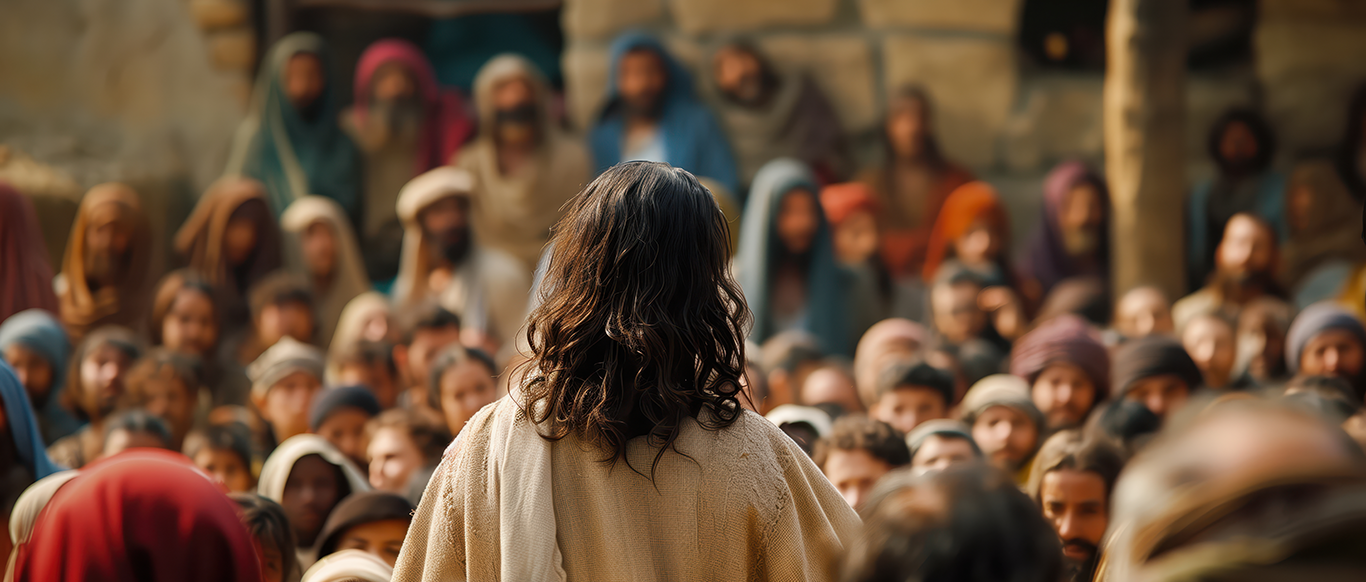
Jesus Christ first spoke publicly at the beginning of his ministry perhaps in the late 20’s AD (CE). Ever since the Lord first projected his inaugural words and vibrated the tympanic membranes of his earliest hearers, Jesus’ ministry and teachings have influenced people, institutions, and cultures near and far for nearly two millennia.
The Literary Record
Four authors known as Matthew, Mark, Luke, and John penned quotes—most likely originally spoken in Aramaic—excerpted from an estimated three years of Jesus’ preaching and teaching. Along with added explanatory details and commentary, their four books became known collectively as the “Gospels” and are included with other religious texts in the book of books commonly referred to as “The Bible.” Divided into an “Old Testament” selection of ancient Jewish holy books originally written mostly in Hebrew and a “New Testament” selection of Christian holy books written mostly in Greek, copies of the Bible were later translated into Latin, English, and many other languages.
In the late 1890’s, Louis Klopsch (1852-1910)—then owner of Christian Herald magazine and fervent proponent of people reading and understanding the Bible—read these words of Jesus Christ, “This cup is the new testament in my blood, which I shed for you” (Luke 22:20 KJV). Aware of the medieval stylistic practice of rubrication—highlighting literary features to draw attention to specific headings, words, or phrases—Klopsch decided to publish the Gospels highlighting the words of Jesus in red letters symbolizing the color of Jesus’ shed blood). He first published The New Testament: With All the Words Recorded Therein, as Having Been Spoken by Our Lord, Printed in Color (1899, New York: World Publishing Company) and then The Holy Bible: Red Letter Edition (1901, New York: World Publishing Company). Others followed suit and have since published additional red-letter editions of the Bible.
A more recent version is The Red Letter Gospel: All The Words of Jesus Christ in Red (2009, 2014, 2017, 2021. Smart Publishing Ltd. Surrey, British Columbia Canada). Compiler Daniel John reports that people regularly ask, “What percentage of the Gospel is just the words of Jesus Christ?” He explains that those books in the English version of the New American Standard Bible (NASB) contain 83,680 words. Combining those into synoptic form and removing duplications reduces the word count to 65,460 words. Of those, original words spoken by Jesus recorded in the four Gospels total 31,426 words.1
Single annual State of the Union messages by U.S. presidents have averaged around 12,500 words. Harry Truman’s 1946 written 27,500-word address almost equates the length the entire body of words the Gospel writers attribute to Jesus. Jimmy Carter’s 1981 record 33,667-word State of the Union message exceeds them.2
Experts assert that people commonly speak at an average rate of 150 words per minute (wpm), although rates vary with context.3 Presenters often range between 100–150 wpm, audio book and radio/podcast speakers between 150–160 wpm, while auctioneers average 250 wpm and commentators 250–400 wpm.4 Taking the number of Jesus’ original words recorded in the Gospels and dividing by a common 150 wpm rate approximates 3.5 hours.5 A slow rate of 100 wpm amounts to just over five (5) hours.6
Five hours.
Five hours—the length of an afternoon—that have influenced major world events, transformational communication technologies, the colonization of countries, the frameworks of governments, the purpose and vision of hundreds of thousands of organizations, and the lives and work of billions of people.
Yet, surely over the course of years in ministry Jesus spoke more than five hours. Studies indicate that some people talk that much in a day and most speak more than that weekly.7 A pastor preaching 20-minute sermons for 50 Sundays a year for three years vocalizes approximately 50 hours of words.8 A full-time college professor teaching for three years talks nearly 300 hours.9 A full-time schoolteacher teaching 180 days per year for three years talks more than 2,000 hours.10 An executive or employee talking four hours per day at work accumulates about 1,000 hours per year and 3,000 hours over three years.11
The author of the Gospel of John—an apostle and close friend of Jesus—asserted that Jesus did much more than what he wrote. “Jesus performed many other signs in the presence of his disciples, which are not recorded in this book,” he summarized. “But these are written that you may believe that Jesus is the Messiah, the Son of God, and that by believing you may have life in his name” (John 20:30-31).
He ended his Gospel reiterating the overwhelming content from among which he selected. “Jesus did many other things as well. If every one of them were written down, I suppose that even the whole world would not have room for the books that would be written” (John 21:25).
Similarly, the other Gospel writers apparently excerpted key information from among a much larger volume of Jesus’ words and deeds.
Suggested Caution
Firstly, no apologist—amateur or professional—can claim with absolute certainty that Jesus NEVER said anything about something unless privy to the vast trove of records of everything Jesus EVER said. Earnestly claiming such either requires access to knowledge unattainable by most, ignorant arrogance, or unbridled hubris.
Secondly, one may certainly assert that Jesus did not appear to directly and specifically address a certain subject in the Gospels. However, some subjects are referenced indirectly, and many are addressed elsewhere in Scripture. If Jesus is the Lord indeed and “in Christ all the fullness of the Deity lives in bodily form” (Colossians 2:9), the words of the Lord throughout the whole Bible should be considered relevant before making any case utilizing the argument that “Jesus never said” one thing or another.
Thirdly, countless topics are not explicitly mentioned among the red-letter words, and many not specifically addressed in the rest of the Bible either. Yet, some non-mentions have been considered significant and even claimed of divine import throughout history.
Fourthly, Ezekiel offers a prophetic warning to vain usurpers who claim to speak for the Lord. “Their visions are false…the Lord has not sent them,” he writes, and “they lead my people astray” (13:6,10). “By lying to my people, who listen to lies, you have killed those who should not have died and have spared those who should not live” (13:19). He conveys the Lord’s promise of punishment “because you disheartened the righteous with your lies, when I had brought them no grief, and because you encouraged the wicked not to turn from their evil ways and so save their lives” (13:22).
Fifthly, claims that “Jesus never said” regularly seem to appear in conjunction with excuses to pardon and often promote what elsewhere and otherwise is considered sinful. Thus, the danger harkened by Ezekiel seems as real today—and probably as prevalent—as in antiquity. Whether prophet or priest, preacher or part-time apologist, advocating “Jesus never said” is a bold claim one should probably never make, certainly not flippantly, and if so, in full acceptance that doing so may fraudulently imperil souls, including one’s own.
- John, Daniel. “How Many Words of Jesus Christ Are Red?” Posted 6/15/2017. Accessed 8/2/2025.
- “Length of State of the Union Messages and Addresses in Words,” The American Presidency Project. Accessed 4/15/2026.
- “Voice Qualities,” The National Center for Voice and Speech. Accessed 8/2/2025.
- Barnard, Dom. “Average Speaking Rate and Words per Minute,” Virtual Speech. Posted 11/8/2022. Accessed 8/2/2025.
- 31,426 words/150 wpm = 210 minutes = 210 minutes/60 minutes per hour = 3.5 hours.
- 31,426 words/100 wpm = 314 minutes = 314 minutes/60 minutes per hour = 5.2 hours.
- Tidwell, C. A., Danvers, A. F., Pfeifer, V. A., Abel, D. B., Alisic, E., Beer, A., Bierstetel, S. J., Bollich-Ziegler, K. L., Bruni, M., Calabrese, W. R., Chiarello, C., Demiray, B., Dimidjian, S., Fingerman, K. L., Haas, M., Kaplan, D. M., Kim, Y. K., Knezevic, G., Lazarevic, L. B., . . . Mehl, M. R. (2025). “Are women really (not) more talkative than men? A registered report of binary gender similarities/differences in daily word use.” Journal of Personality and Social Psychology, 128(2), 367–391.
- Pastor calculation based on 20 minutes per week, 50 weeks per year for three years = (20 min/wk x 50 wks/yr) x 3 yrs = 3,000 minutes, or 3,000 min/60 minutes/hr = 50 hours.
- Professor calculation based on a 3-hour course teaching 2.5 hours/week for 13 weeks per semester for 3 courses/semester for 3 semesters/year = [(2.5 hrs/wk x 13 wks) x 3 sem/yr] x 3 yrs = 292.5 hours.
- Schoolteacher calculation based on 4 hours per day for 180 days for 3 years = (4 hrs/day x 180 days/yr) x 3 yrs = 2,160 hours.
- Employee calculation based on 4 hours per day, 5 days per week, and 50 weeks per year for three years = [(4 hrs/day x 5 days/wk) x 50 wks/yr] x 3 years = 3,000 hours.
Originally published in The Sentinel, Summer 2026, pp. 15-17.